Best Salmon Lures for Trolling - No Bananas for the W
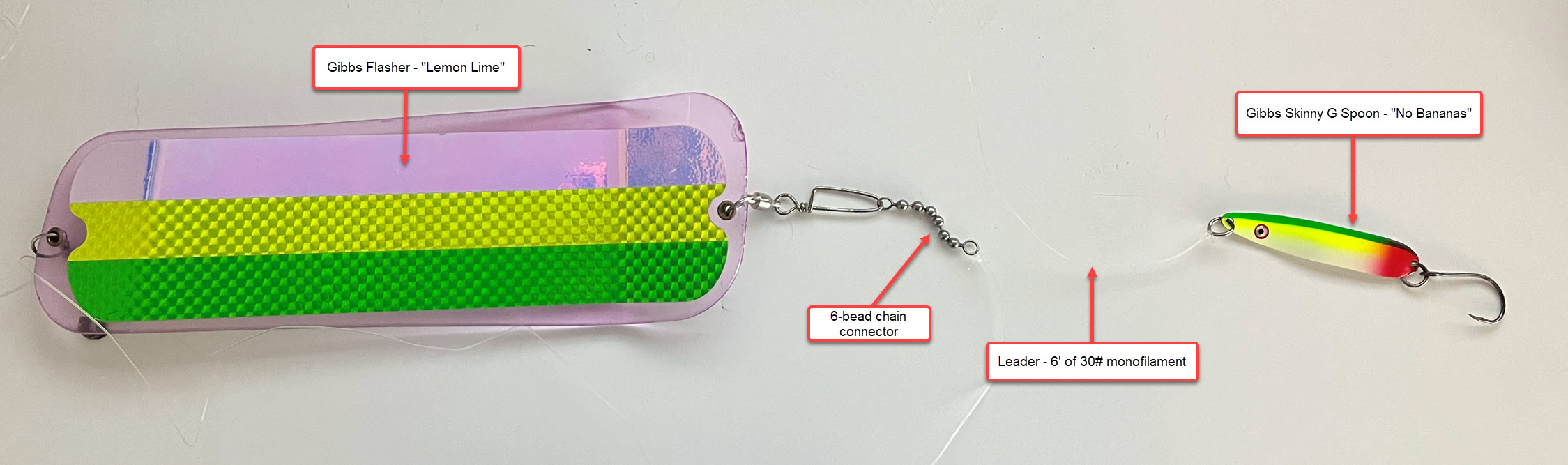
I love trolling spoon for salmon here in the Pacific Northwest. I love to experiment with different colors and patterns, depths, speeds, scent, etc. In this article I'm outlining my most effective spoon setup for trolling salmon in the ocean. I'm focusing on one single setup and primarily on one single spoon. I hope you find it insightful.
Fishing Shallow and Deep water Light Conditions
Most often I'm fishing in my kayak and trolling this setup at all different depths between 50 to 130 feet deep. At the deepest there isn't much light and having some glow is important. This is even more important when you've got a heavier cannon ball and fishing much deeper (200+ depth ranges).
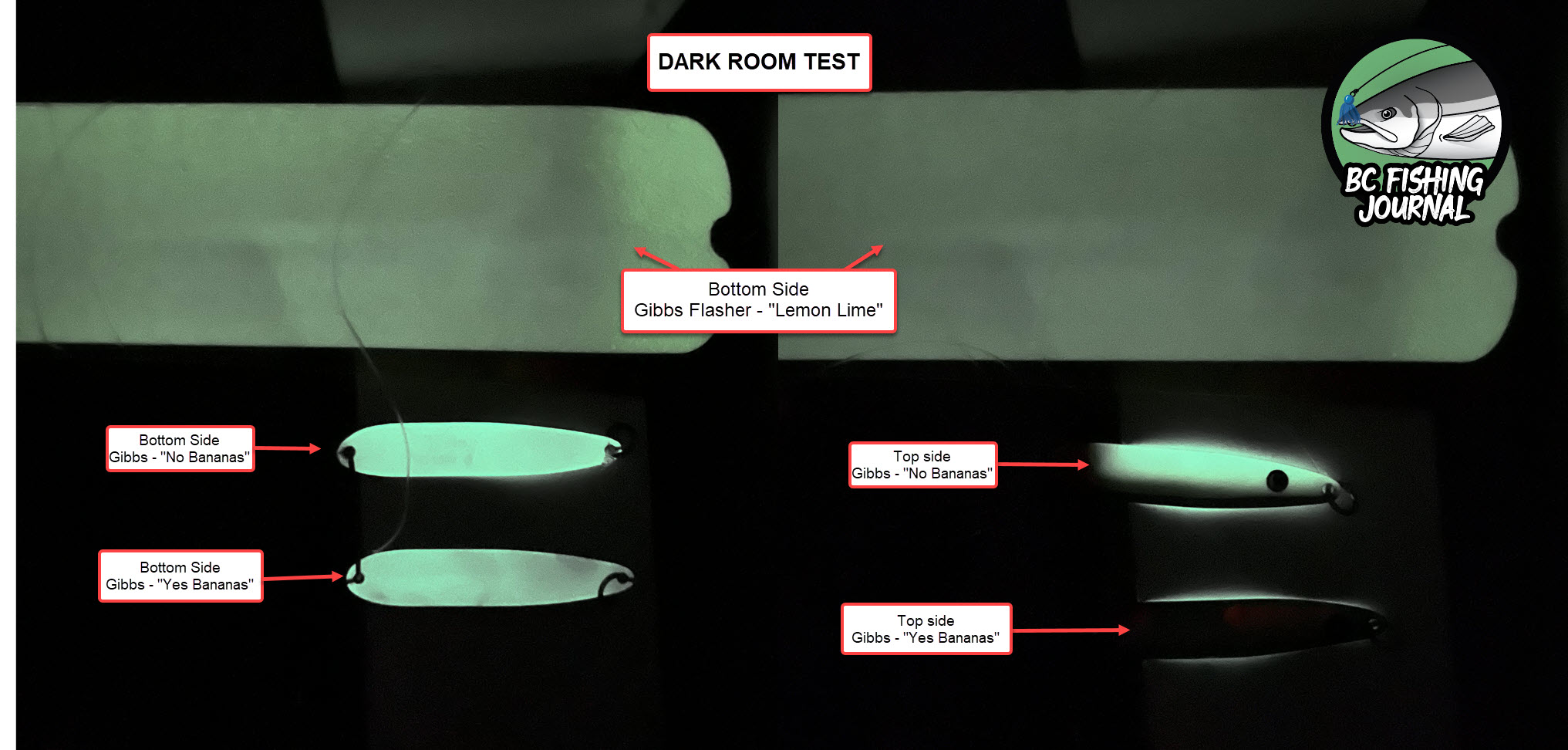
With this Gibbs setup, I've found it works great in both shallow and deep water conditions! One thing you might be shocked is how effective it works also in deeper water, as you can see by my dark light test (below) the spoon and flasher glow is substantial.
One thing to note, this flasher is an older one and hasn't had any UV light applied to it. So it could be much brighter in this test if I applied some UV light to it for a few minutes. Anglers may call this "charging the flasher", adding that uv light to brighten up the moon jelly glow tape. This is a common technique for anglers especially when they are fishing deep.
Dark Light test
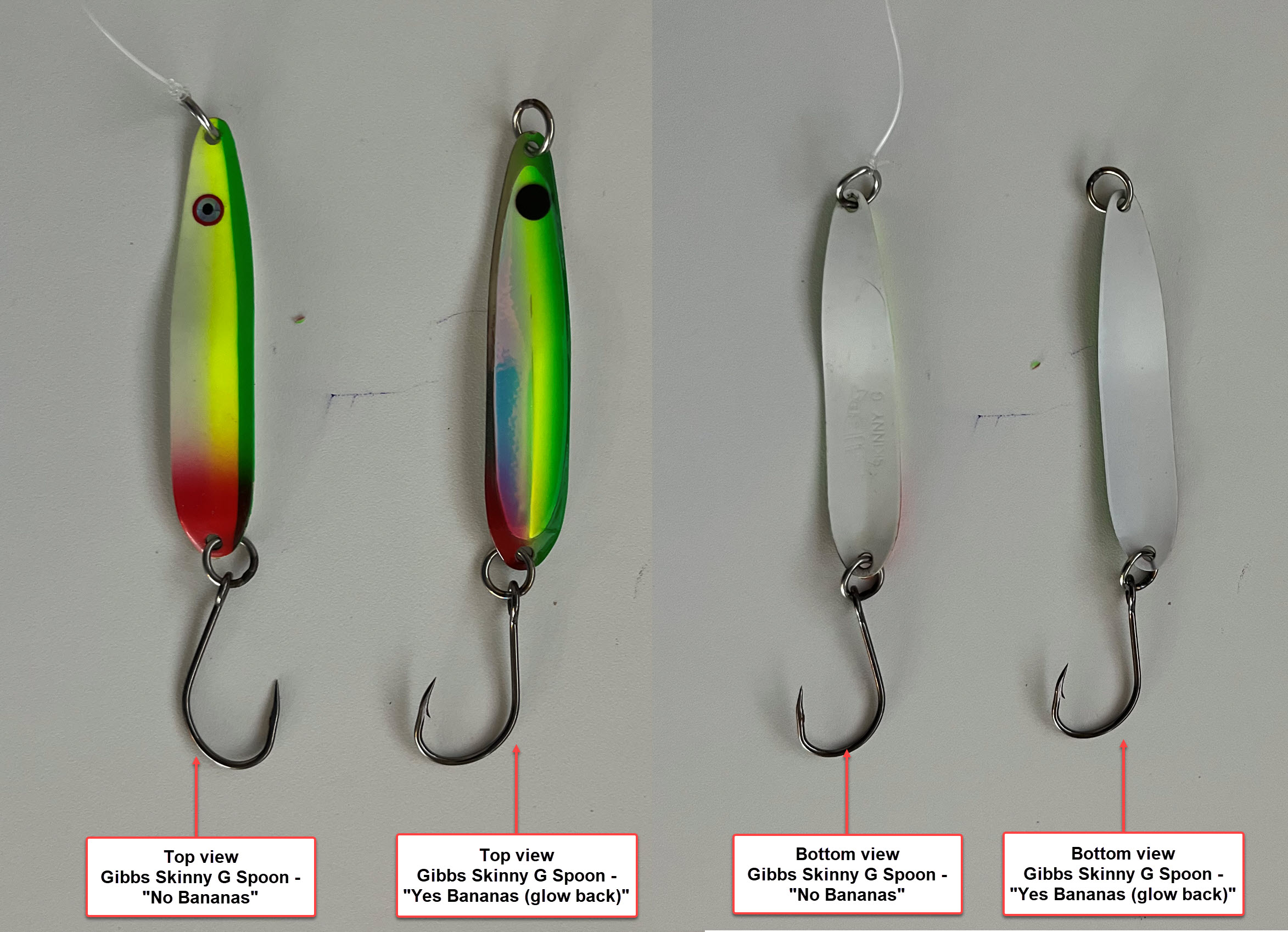
For this dark room test I looked at the Gibbs spoons: "No Bananas", "Yes Bananas (glow back)" and the "Lemon Lime" flasher. The "Yes Bananas" spoon is a new version of the "No Bananas" with a glow back and glossier front.
I took photos of the spoons from the top view (painted) and bottom view (white glow side). Both these spoons were essentially out of the box with no additional uv charge to either of them. I found it VERY interesting that the "Yes Bananas" had less of a glow than the original "No Bananas"! The "No Bananas" continues to be my go to spoon lure for any depths.
What Leader to use for Trolling a Spoon
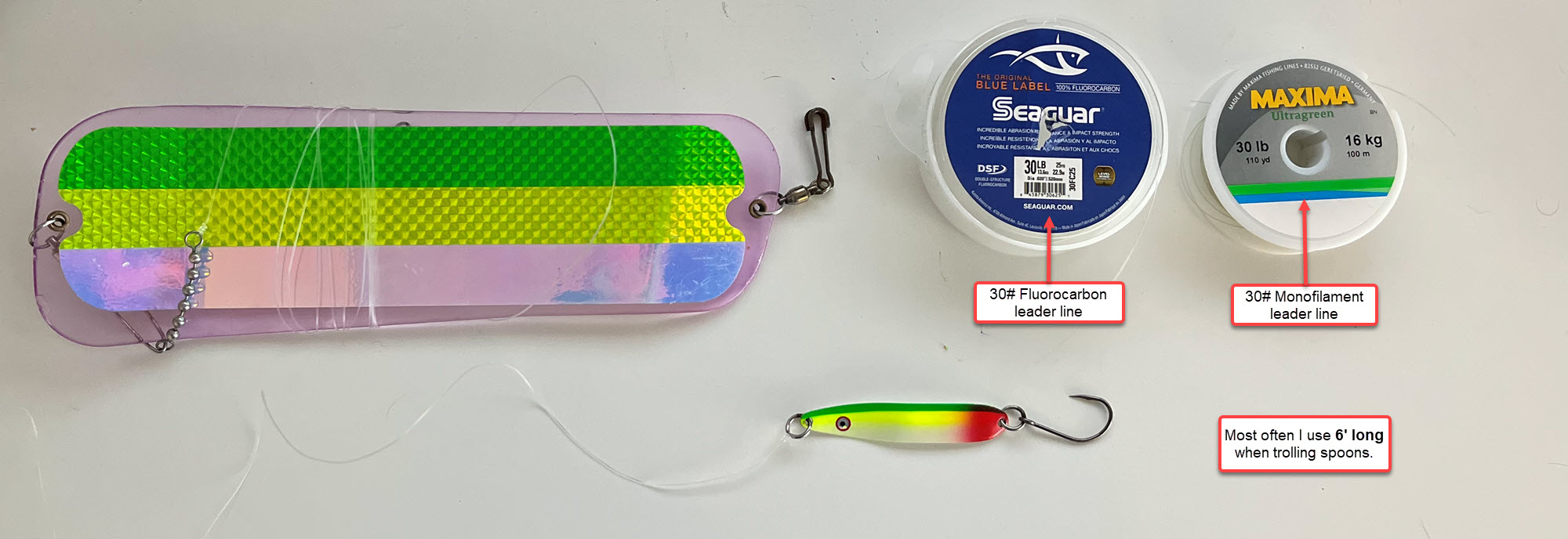
I primarily use 6' of 30# monofilament leader line for targeting Salmon. Spoons provide most of the action necessary when trolling so I like having a less rigid line like mono vs. fluorocarbon which can provide more of a whipping action (better suited for hoochies). That said, if you do want more action on your spoon, shorten up your leader line to 4' if you're using a flasher as the spin will give the spoon some additional movement. The times I shorten my leader would be the summer or the peak of salmon fishing season where are there are more aggressive fish around. If you want more information on leader lines check out my article that covers leaders for hoochies and bottom fishing.
What Speed to Troll for Salmon with a Spoon?
Trolling speed is not easy as most salty anglers will tell you they dictate the speed by the angle of their downrigger. And I like that approach because we're factoring in the tide to that equation. Meaning, 2.5 mph with the tide vs. 2.5 mph against a tide will represent completely different speeds for your bait. When you can monitor your downrigger line to find that 45 degree angle (or somewhere in that range) you'll be able to find that speed will never be a static number. I hope that makes sense.
If that doesn't make sense I typically have a general range speed range of 2.5 to 2.7 mph. For Chinook I may slow it down a little bit and for Coho I'll often speed it up. For example: Chinook/King salmon I may go: 2.2 to 2.8 mph and for Coho/Silver salmon I may go: 2.8 to 3.5 mph.
In the winter time, I'll slow down quite significantly. For winter Chinooks, I'll go down to a 2.0 mph. I guess all this to say, speed is something you should be playing around with if you're having a slow day. Trying varying your trolling speed or perhaps toss some more S- lines and turns in your route. Little things can trigger that bite!
Final Thoughts
The Gibbs "No Bananas" spoon has become so popular here on the west coast that I've started to see other spoon manufacturers create their own "No Bananas" patterns in their spoon molds. And they often name it "No Bananas" too! Haha.
Anyway, I'm not alone in calling the "No Bananas" my favorite spoon, I've got several angling friends who swear by it as well. It's an incredibly versatile spoon and fishes really well behind any type of flasher and a variety of different water depths.
Check out a video of me catching a bunch of Chinook Salmon with the No Bananas setup